Maddie Prater
eSomethin Staff
There’s a lot of talk about Immigration and Customs Enforcement (ICE) on social media, the news, and in classrooms. Like all big topics, there’s a plethora of mixed information, leaving confusion and unanswered questions.
According to Education Week, half of the educators surveyed across the country say that they have students that are worried about immigration enforcement.
The previous federal policy for ICE was that places like schools, churches, and related areas were considered “sensitive,” and they were restricted from enforcement on those grounds.
The new policy, created by the Trump administration in early 2025, says that Immigration Enforcement is allowed within those previously restricted areas as long as they have a judicial warrant or “secondary supervisor approval before any action in locations such as a school” according to The Department of Homeland Security.
Hundreds of schools across the U.S have adopted anti-ICE policies in the event of Immigration officers showing up at their door – policies like specific staff training, lists of requirements, and major focus on student privacy and information.
So, what’s our blueprint at PHS?
According to Chris Harper, the director of student services and wellbeing in Perrysburg, ICE will not be allowed to operate on Perrysburg’s school grounds “unless it is the absolute last option.”
All outside law enforcement requires a federal warrant signed by a federal judge in order to enter a private space, such as inside a school. They are, however, allowed to be in public areas including the front doorway, outside, and the playground. The warrant must be valid and specific about what they are doing.
“They cannot get past that door without administrators knowing and with a federal warrant,” said Harper.
If all the documentation is valid, the school will go into a lockdown procedure until the situation is resolved. Immigration enforcement would be kept in the office while all parents and administrators are notified.
“This is how we deal with all outside law enforcement,” Harper said. “Our goal, in any circumstance, is to make sure that our students are safe.”
The rising distress over incidents of ICE “camping” outside of private establishments provoked this question: what will schools in Perrysburg do if ICE is waiting outside for students?
To start, the school would not release students as normal. No one would be allowed to leave the building until the issue is cleared. Parents and administration are going to be informed in every circumstance of an ICE contact at school.
In the event that Immigration Enforcement is at a bus stop, the driver would keep moving past the stop and immediately notify administration as well as transportation services.
All Perrysburg Schools staff has been informed of the proper procedures and steps to if immigration were to show up.
Harper said that she’s “not necessarily” concerned that this will happen, but the district is staying prepared in case it does.
The role of internal law enforcement
PHS’s school resource officer Greg Cole said that his job in the event of an ICE investigation is to “verify the federal warrant” and “act as an intermediary between the school and officers.”
A judicial warrant is signed by a federal judge. Evidence is presented to the courts, with specific details, and a warrant is produced if the judge deems it suitable.
An administrative warrant is a warrant signed by the supervisor of the agency, rather than a judge. It does not allow access to private property, as a judicial warrant does.
Officer Cole stated that he would not accept an administrative warrant to access the building.
Since Officer Cole is an SRO, his job is internal law enforcement. This means he doesn’t necessarily require a warrant to make an arrest inside Perrysburg Schools.
Students Speak Up
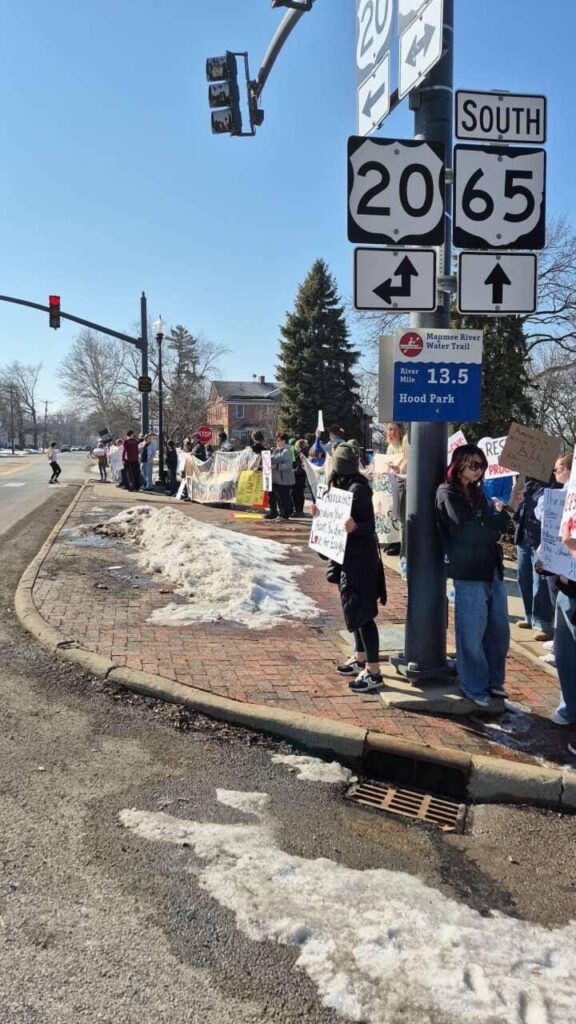
Earlier this month, students at the high school hosted an ICE-OUT protest in downtown Perrysburg. They stood with signs and banners showing their opposition to the growing mass deportations across the nation.
Landyn Altherr is a sophomore at PHS who participated in the protest.
“I don’t like what ICE is doing. If I live in Toledo and want to move to Perrysburg because I believe it’s a better place to live I don’t have to wait years and take tests and fill out all of this paperwork. So why do immigrants coming from Mexico have to,” Altherr said.
“And then taking families and children from their homes and deporting them is inhumane,” he said.
Gavin Rice is also a freshman at PHS who participated in the rally against ICE.
“They [ICE agents] use unmarked vehicles and have face coverings on constantly,” Rice said.
“They are not only deporting people without any due process, they are deporting U.S citizens in the process. It was claimed that the ‘illegal immigrants’ are violent criminals, but if that were the case they wouldn’t be deporting children as young as four years old.”
According to PBS and CNN news, Liam Conejo Ramos, a 5 year-old, was arrested and taken to a detention center in Texas along with his father by immigration customs. He was later released from custody by court order.
“There have been countless reports of people detained by ICE experiencing assault from officers and inhumane conditions,” Rice said.
Many students have chosen to speak up and use their voices for what they believe in hopes to make a mark.
The statistics of anti-ICE activism including walkouts and rallies by students across the nation have soared into the thousands in 2026 alone.
On January 30, students from all over the U.S initiated a “National Shutdown” movement. With strikes involving walking out of classrooms and flooding everything from media to mirrors, forcing the country to reflect on the pressing situation.
Perrysburg continues to reflect
In relation to a previous incident that happened last year around a 24 year old posing as a 16 year old student, a lot of questions were left behind.
Anthony Labrador-Sierra, the individual in question, was a Venezuelan immigrant who entered under false pretenses. His federal documentation was validated fraudulently, allowing him to enroll in the district.
Labrador-Sierra, was sentenced to 24 months in prison by U.S. District Judge James R. Knepp after pleading guilty in September to “Making or Using False Writings or Documents,” among other charges.
As ICE activity gets bigger, voices get louder. Millions of students and adults are speaking up, seizing the microphone and making sure their voices are heard.
Other stories on eSomethin:
- Building up the BAND-width: Two schools, one massive sound
- Breaking News: Residents of Toledo under duress and Perrysburg citizens under stress after a major chemical spill occurs
- Jacket Time is a controversial addition to the schedule at PHS
- Homecoming hits with students – many want to go again
- Perrysburg High School students and principal comment on Decision Day